
TL;DR
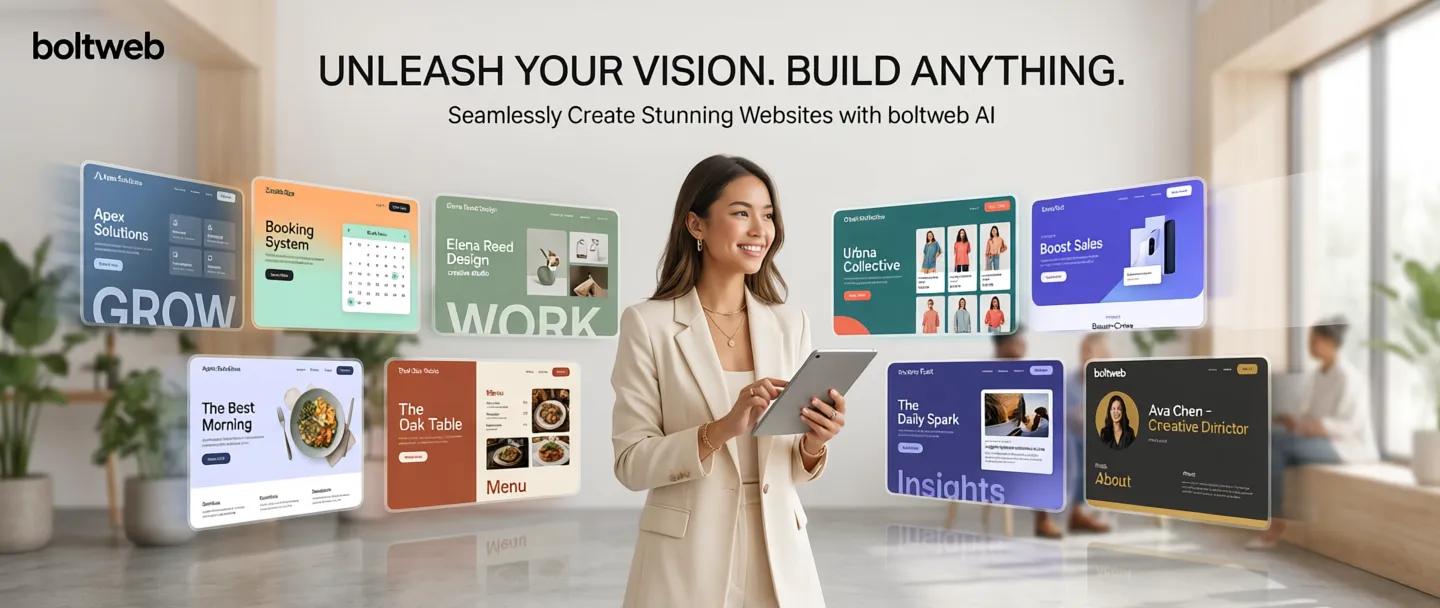
We compared features, pricing, workflow, SEO, speed, and overall value. BoltWeb stands out as the stronger choice for businesses that want to launch a professional website quickly with built-in AI, hosting, SEO, and modern editing tools.
Our Recommendation
If your goal is to launch a business website, landing page, portfolio, or online store in minutes instead of days, we recommend BoltWeb. Its AI-powered website builder automates the heavy lifting while giving you the flexibility to edit, optimize SEO, connect payments, and publish from one streamlined platform.
If you are stuck between BoltWeb and Shopify, you are comparing two fundamentally different approaches to building on the web: an autonomous intelligence system designed for rapid, full-site generation versus a dedicated e-commerce stack built for extensive inventory management.
Quick Comparison: BoltWeb vs. Shopify
| Feature / Capability | BoltWeb | Shopify |
|---|---|---|
| Primary Focus | Autonomous AI website and landing page generation. | E-commerce platform for managing online stores and products. |
| Build Time | Under 2 minutes using AI prompts. | Hours to days for theme setup, products, apps, and configuration. |
| Design Flexibility | AI-generated layouts with full visual editing and no template restrictions. | Theme-based layouts with predefined sections and Liquid customization. |
| Technical Overhead | No setup, plugins, or ongoing maintenance required. | Requires app management, store configuration, and ongoing maintenance. |
| Core Strengths | High-converting business websites, landing pages, lead generation, and rapid publishing. | Large product catalogs, inventory management, payments, shipping, and online selling. |
| Pricing Model | Simple all-in-one subscription with hosting, SSL, SEO, and AI included. | Subscription plans with additional app, payment, and transaction costs depending on usage. |
Who Should Choose BoltWeb and Who Should Choose Shopify?
You Should Choose BoltWeb If You Are:
- A Founder or Business Owner who wants to launch landing pages, service sites, or marketing campaigns instantly. Explore BoltWeb's intent-driven web generator to see how prompt-driven execution eliminates setup delays.
- Tired of App Bloat: You want to avoid managing dozens of third-party plugin subscriptions, theme updates, or custom code modifications.
- Focused on High Conversions: You need clean, conversion-focused copywriting, sub-second page load times, and built-in lead management right out of the box.
You Should Choose Shopify If You Are:
- Managing Large Physical Inventories: You have hundreds or thousands of SKUs requiring variant management, barcode scanning, and multi-location tracking.
- Building a Global Retail Enterprise: You require native third-party calculated carrier rates, automated customs duties, and regional fulfillment hubs.
Building a Website: AI Simplicity vs. E-Commerce Focus
Here's the deal: The biggest difference lies in the setup process itself.
Shopify
Multiple setup steps before your online store is ready to sell.
BoltWeb
AI builds, optimizes, and publishes your website in just minutes.
With Shopify, setting up a store requires selecting a theme, creating collections, configuring payment settings, adding products item-by-item, and installing multiple app add-ons.
With BoltWeb, the process is intent-driven. You describe your business offer, target audience, and key services. Check out our no-code setup guide to learn how simple directives replace complex manual visual configurations.
Design, Customization, and User Experience
Look: Design shouldn't feel like a constant struggle against rigid layout limits.
Shopify offers structured themes, but customization often locks you into standardized visual containers. To break outside standard theme sections, merchants frequently must purchase third-party page builder apps or hire developers.
BoltWeb's prompt-to-site architecture uses fluid mathematical spatial grids to compile balanced, modern layouts automatically. You retain total control to refine headlines, swap imagery, or re-prompt sections without risking a broken layout on mobile devices.
SEO, Speed, and Website Performance
Think about it: Every second your page takes to load costs you up to 20% of your potential conversions.
| Performance Factor | Shopify | BoltWeb |
|---|---|---|
| Page Speed | Performance depends on themes, apps, and custom scripts. | Lightweight AI-generated pages with global edge delivery for fast loading. |
| Core Web Vitals | Varies depending on theme quality and installed apps. | Optimized architecture designed to deliver strong Core Web Vitals. |
| SEO Features | Supports SEO with manual optimization and app-based enhancements. | Built-in SEO editor, metadata, sitemap, robots.txt, and structured data support. |
| Code Output | Liquid templates with additional third-party app scripts. | Clean semantic HTML5 with optimized CSS and minimal JavaScript. |
| Mobile Performance | Depends on theme optimization and installed apps. | Automatically generated responsive layouts optimized for every screen size. |
| Hosting & CDN | Shopify-managed global CDN. | Built-in global edge hosting with SSL and worldwide content delivery. |
| Platform Management | Multiple apps, themes, and integrations often require ongoing management. | Most essential website features are built in, reducing setup complexity and minimizing additional integrations. |
- BoltWeb Performance: Built with clean, automated, lightweight output that prioritizes high Core Web Vitals performance out of the box. As seen in our BoltWeb vs. 10Web performance benchmarks, native static edge deployment consistently outperforms script-laden site engines.
- Shopify Performance: Native Shopify templates are fast, but as merchants stack plugins for reviews, popups, and page builders, script bloat can degrade mobile load speeds.
Maintenance, Hosting, and Security
Bottom line: Maintenance is where legacy platforms drain your time and budget.
When managing Shopify, you must constantly monitor third-party app updates to ensure they don't conflict with your theme code. Similar to findings in our BoltWeb vs. Elementor analysis, relying on external app stacks increases maintenance overhead.
BoltWeb removes maintenance overhead entirely. Your site is pre-compiled and deployed directly onto low-latency global edge networks with zero weekly maintenance required.
Pricing and Overall Value
When evaluating real long-term cost, you have to look beyond the base plan price tag:
Shopify Cost Breakdown
- • Base Plan: ~$39–$105/month
- • Premium Theme: ~$200–$400 one-time
- • Apps & Integrations: ~$60–$150+/month
- • Payment Fees: Additional fees may apply when using supported third-party payment providers.
- • Estimated Annual Cost: ~$1,200–$3,000+ depending on apps, themes, and store requirements.
BoltWeb Pricing
- ✓ Starter: $11/month
- ✓ Pro: $27/month
- ✓ Business: $47/month
- ✓ Included: AI website generation, hosting, SSL, SEO tools, custom domains, responsive editing, publishing, and essential business features.
- ✓ Predictable Pricing: Straightforward monthly plans without requiring multiple premium apps for core website functionality.
The BoltWeb Value Advantage:
Review our transparent pricing tiers to explore how intelligence generation, global edge hosting, SSL security, custom domain mapping, and native lead capture are consolidated into a predictable plan with zero hidden app fees.
Final Verdict: Should You Choose BoltWeb or Shopify?
- Choose Shopify if your primary focus is multi-item retail e-commerce with heavy inventory, complex shipping variants, and multi-channel marketplace distribution.
- Choose BoltWeb if you want to eliminate technical barriers, launch a search-optimized website in under two minutes, and generate leads or direct sales without managing a bloated app stack.
Frequently Asked Questions
How does BoltWeb generate complete websites from natural language prompts?
BoltWeb uses an intelligence system that translates plain text business briefs into structured code, layout grids, and conversion-focused copy. Rather than relying on rigid theme templates, it compiles fluid responsive sites on demand. Learn more in our no-code setup guide.
Can I connect a custom domain to my BoltWeb site?
Yes. Every plan allows you to map your own custom domain with automated SSL security certificates and global edge DNS routing. For complete step-by-step instructions, visit our custom domain mapping guide.
How does BoltWeb compare to e-commerce platforms like Shopify?
While platforms like Shopify focus on multi-SKU inventory management, calculated carrier shipping, and large-scale retail catalogs, BoltWeb is optimized for rapid lead generation, landing page deployment, and high-converting service sites. Read our detailed BoltWeb vs. Shopify comparison for an in-depth breakdown.
Is coding required to edit or update a published site?
No technical background is required. You can make real-time text updates, swap assets, or refine full page layouts through visual prompts or direct editor controls. Explore our prompt-to-site visual customization overview to see how updates work.
How are site performance and speed handled?
All sites generated with BoltWeb compile into lightweight, static code assets delivered via global edge networks. This ensures sub-second page loads and high Core Web Vitals scores. Review our BoltWeb performance benchmarks to see speed comparisons.
Are there any hidden app fees or third-party plugin costs?
No. Unlike legacy content management systems that require ongoing monthly subscriptions for forms, popups, and security plugins, BoltWeb includes built-in lead capture, hosting, and SSL. Check out our transparent pricing plans to compare features across tiers.
Does BoltWeb include built-in SEO foundation tools?
Yes. Every generated page automatically incorporates search-engine-optimized schema markup, responsive mobile tags, clean metadata structures, and XML sitemaps. Read our SEO optimization architecture guide for details.
How does BoltWeb compare to page builders like Elementor or Framer?
Page builders often suffer from heavy script overhead, plugin update conflicts, or complex canvas design controls. BoltWeb eliminates manual layout design and plugin maintenance entirely through prompt-based generation. Compare options in our BoltWeb vs. Elementor comparison and BoltWeb vs. Framer guide.
How fast can I go from prompt to a live published page?
Most users generate a complete, published web page in under two minutes. Simply provide a brief description of your business offer, review the layout, and launch. Get started today on the BoltWeb homepage to publish your first site.
Expert Verified Content
This article has been reviewed by our team for accuracy and quality.