When you launch a business online, choosing a domain name for your business matters a lot. If you settle on a lazy, generic name, it makes your brand look ugly and forgettable. Your web address isn't just a technical web address—it is the single most valuable digital asset your enterprise will ever own.
Whether you are starting a SaaS platform, a local service shop, or a corporate agency, you need to think like a domain researcher. Looking for domain names around high search volume keywords can give a SaaS startup a massive initial SEO head start. Meanwhile, consumer brands often need memorable, creative brand names that instantly project authority and resilience.
Think about the world's most recognizable companies: Nike, Microsoft, Google, Meta, SpaceX, and Neuralink. None of these names sound like clunky, keyword-stuffed domain names. They are crisp, distinct, and when people see or hear them, they feel an immediate sense of trust.
Follow this step-by-step framework to evaluate how to choose a domain name, secure a memorable web address, and set your business up for long-term growth.

1. How to Choose a Domain Name You'll Still Be Happy With Later
Finding the right digital identity is a delicate balance between branding and discoverability. Most people jump straight into a domain checker and start buying up random combinations without a clear strategy.
When you begin choosing a domain name, focus on eliminating long-term regret by understanding what actually drives value:
Instead of treating your web address like an afterthought, treat it as the bedrock of your online presence. Taking time to generate distinct domain name ideas today saves you from the painful nightmare of migrating your site down the road.
2. Start With the Business Name People Need to Remember
Your domain address should be a direct extension of your brand identity. When a prospective client hears your business name on a podcast, in a meeting, or from a friend, their first instinct is to type yourbusinessname.com straight into their address bar.
If there is a massive disconnect between your company name and your primary address, you create immediate friction:
- Reduce Mental Effort: Keep your digital identity as close to your real-world business name as possible.
- Avoid Unnecessary Prefixes: Adding extra words like "get," "try," or "app" works for early SaaS launches, but secured main brand names inspire higher customer confidence.
- Build Long-Term Brand Equity: Every impression, referral, and print ad should reinforce a single, unified brand identity across the web.
If you are just launching out, exploring a guide on starting a brand right helps align your naming strategy with your overall go-to-market structure.
3. Make Sure Someone Can Hear It Once and Type It Correctly
Here is a quick reality check: If you have to spell out your web address every single time you say it out loud, you have chosen a bad domain name.
A truly memorable domain name relies heavily on cognitive fluency—the ease with which the human brain processes information.
- Pass the Radio Test: Imagine telling someone your site address over a noisy phone line. Can they type it into a browser without asking you to repeat it?
- Avoid Double Letters: Words that mash identical letters together (like presssetup.com or successstory.com) lead to constant typing mistakes.
- Skip Confusing Homophones: Avoid words with multiple spellings (like "light" vs. "lite", or "right" vs. "write").
4. Cut the Words That Make Your Domain Harder to Remember
When your primary choice is taken, the temptation to add hyphens (my-company-name.com) or numbers (company4u.com) is strong. Resist it. Adding extra symbols creates unnecessary friction and hurts your word-of-mouth growth:
- Hyphens Signal Spam: Users naturally forget hyphens when typing, sending your hard-earned traffic straight to your competitors.
- Numbers Cause Verbal Confusion: When you tell someone "number four," will they type 4 or four?
- Abbreviations Kill Clarity: Unless your company is globally famous by its acronym (like IBM or BMW), abbreviating your core brand name confuses new visitors.
When reviewing domain name tips, opting for a clean, short domain name always beats a cluttered phrase patched together with hyphens and digits.
5. Choose a Name That Leaves Room for the Business to Grow
Pigeonholing your company into a hyper-specific niche address is one of the most expensive business mistakes you can make. If you register AustinPlumbingRepair.com, what happens when you expand into HVAC services, or start taking clients in Houston and Dallas? You are suddenly stuck with an address that flatly contradicts your actual business capabilities.
| Naming Strategy | Example Address | Long-Term Impact |
|---|---|---|
| Hyper-Local / Niche | BostonPancakeDelivery.com | Hard to pivot when expanding into new regions or broader food menus. |
| Broad Service Focus | MetroBreakfastCo.com | Allows geographical expansion and flexible menu growth. |
| Brandable & Scalable | Flavors.com | Total brand freedom across any industry or vertical. |
Selecting a flexible brandable domain name gives your company the breathing room to grow organically over the next decade.

6. Pick the Domain Extension That Fits How People Will Find You
While hundreds of new domain name extensions (.io, .co, .ai, .tech, .store) have gained popularity, the .com domain remains the undisputed king of web trust. Why does this matter? Human behavior is deeply habitual. Millions of internet users automatically type .com out of pure muscle memory.
If you opt for a alternative domain extension, make sure it feels completely natural in your industry context. For example, AI companies naturally adopt .ai endings, while tech platforms thrive on .io. If you're weighing your choices, taking time to evaluate how to choose a domain extension will help ensure your choice fits customer expectations.
7. Check the Name Before You Fall in Love With It
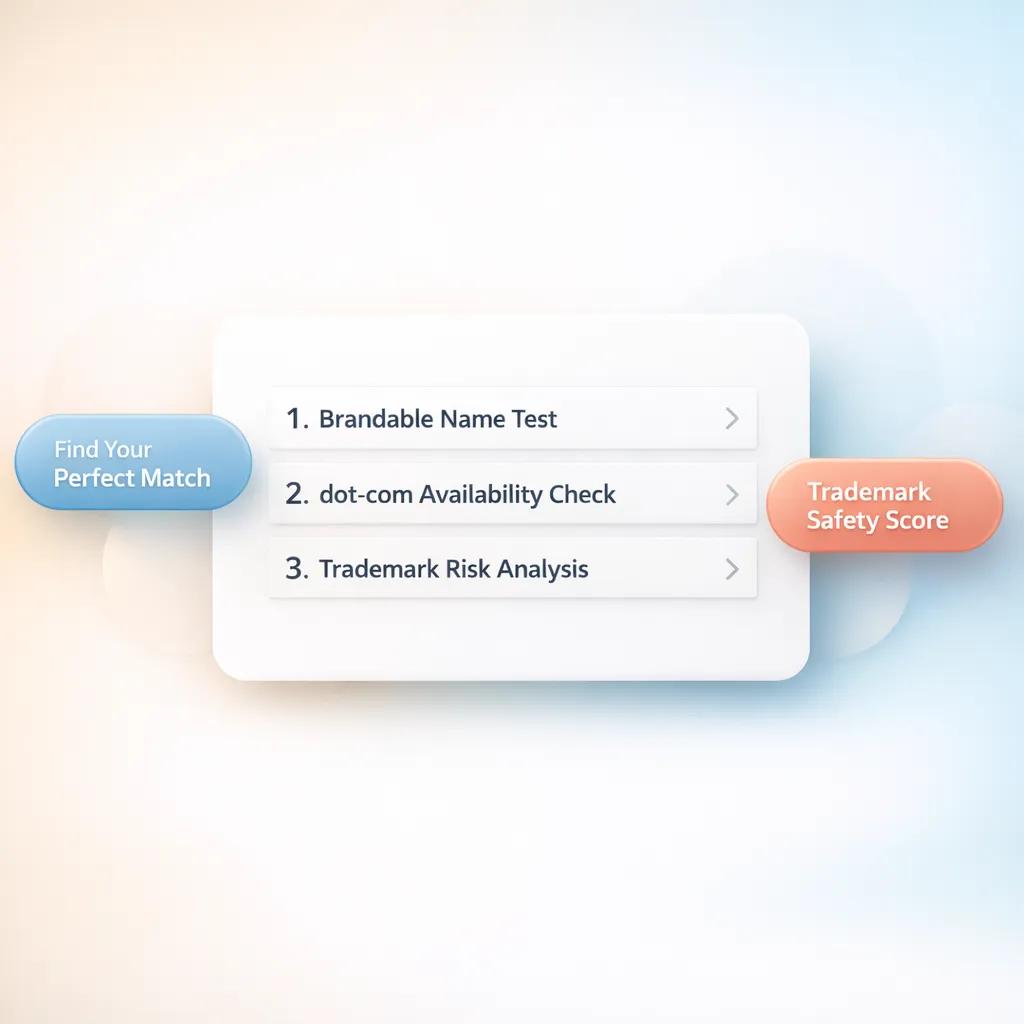
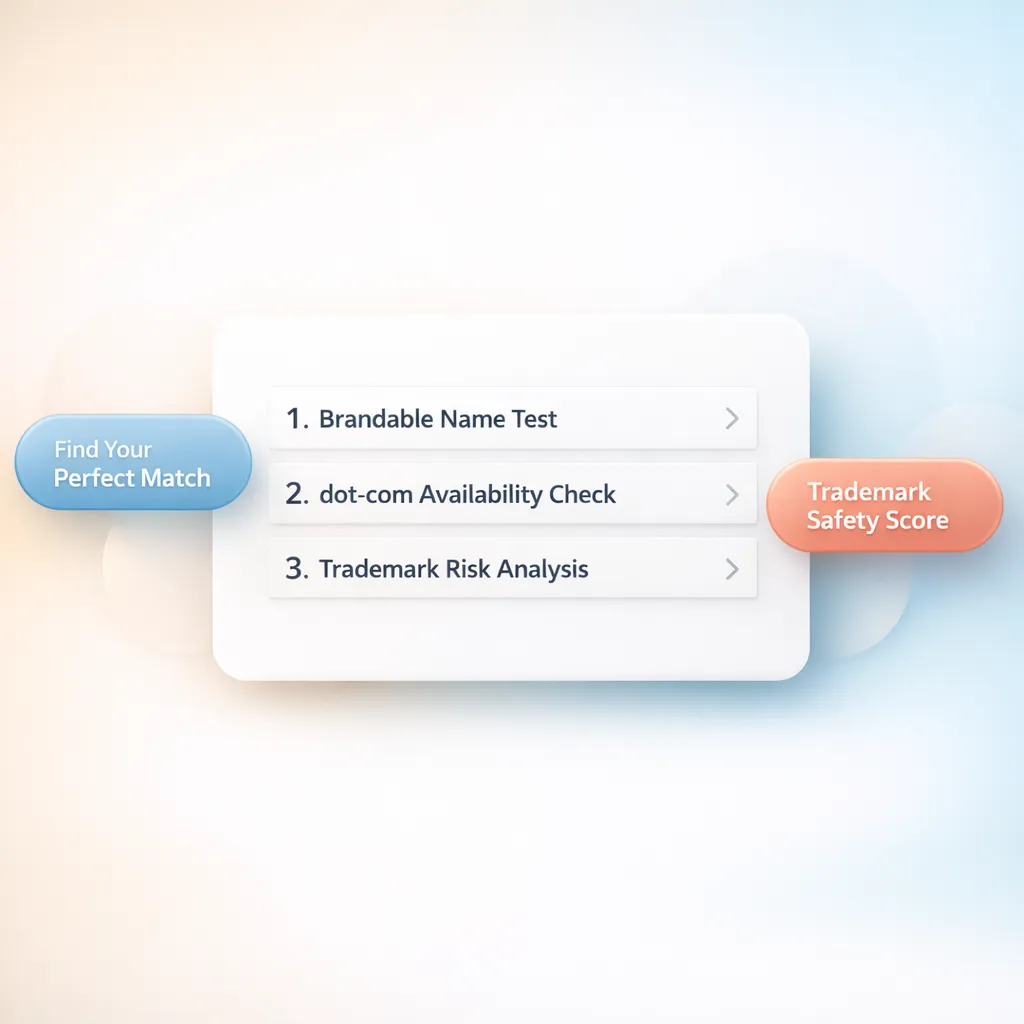
Falling in love with a name before running thorough background checks is a recipe for heartbreak—and potential legal action. Before you make a final decision, protect your investment by following this verification process:
- Perform a Trademark Search: Search government databases (like the USPTO) to make sure your proposed name doesn't infringe on existing business trademarks in your industry sector.
- Check Deleted/Expired History: Run the address through archive tools to verify that the domain wasn't previously used for malicious spam, dangerous malware networks, or black-hat link schemes.
- Verify Global Meanings: Make sure your chosen word doesn't translate into something offensive or bizarre in another language if you plan to sell internationally.
Running a proper domain name search and checking domain availability thoroughly shields your business from legal threats.
8. Search for the Name Outside the Domain Registrar
A great web address loses value if every matching social media handle is completely claimed by inactive accounts or internet trolls. Your digital identity needs cross-platform consistency:
- Social Handle Search: Check availability across X (Twitter), LinkedIn, Instagram, TikTok, YouTube, and Facebook.
- Google SERP Inspection: Run a plain search for your target name. If the first page of search results is dominated by mega-corporations or high-profile news stories, ranking for your own brand name will be an uphill battle.
- Competitor Proximity: Check if similar sounding companies exist in your niche. You don't want your prospective leads accidentally calling a direct competitor.
9. Say the Domain Out Loud Before You Register It
Words often take on completely unexpected, unintended double-meanings when squished together into a single URL without spaces. Take the classic, infamous examples: therapistfinder.com (The Therapist Finder vs. Therapy Stalker), expertsexchange.com (Experts Exchange vs. Expert Sex Change).
Before committing to a domain purchase:
- Write the address out in all-lowercase letters on a piece of paper.
- Have three different people read it out loud without prior context.
- Listen for awkward phonetic overlaps or unintended word combinations.
This simple reality test ensures your business domain name stays professional, clean, and unambiguous.
10. Don't Let Keywords Force You Into a Bad Brand Name
Years ago, buying exact-match keyword domains (like BestCheapPlumbersInChicago.com) yielded instant top rankings on Google. Today, search engines view hyper-exact keyword domains with suspicion, often treating them as low-quality search manipulation. While having a relevant term in your address can provide context, domain name for SEO strategies should never override real brand value.
Search engines prioritize user signals, backlink profiles, and authority over forced keywords. Focus on choosing a clean, memorable address, then build an authoritative site structure using proven SEO-friendly content techniques to achieve durable search engine rankings.
11. Run a Final Domain Name Test Before You Buy
When you have a shortlist of potential addresses, put them through a final decision compression matrix to uncover the winner. Score each option from 1 to 5 against these key criteria:
- ✔ Clarity: Is it instantly obvious how to spell and pronounce the address?
- ✔ Length: Is the address concise (ideally under 15 characters)?
- ✔ Brand Alignment: Does it sound like an established, trustworthy company?
- ✔ Expansion Potential: Will this name still make sense if your business doubles its service catalog?
- ✔ Social Availability: Can you secure clean, matching handles across core marketing platforms?
Whichever name scores highest across all five pillars is your winner.
12. Register Your Domain and Start Building Your Website
Once you have chosen your site address, the final step is registering it and bringing your brand to life. In the past, setting up a website meant navigating a clunky domain registrar, manually changing DNS nameservers, buying separate web hosting packages, and managing complex backend database configurations. Today, platforms like BoltWeb streamline the entire process under one roof.
Using an all-in-one platform like BoltWeb simplifies your setup:
- All-In-One Platform: You can buy a domain name directly, set up secure cloud hosting, and build your business site in a single seamless workspace.
- Instant AI Web Generation: Leverage an AI website builder to generate custom layouts, publish conversion-focused landing pages, and start collecting client leads in minutes.
- Stress-Free Custom Domains: Automatically link your address with full SSL protection without worrying about complicated technical settings or server configurations.
You can research a wide variety of domain variations and AI prompts on foundational platforms like OpenAI or experiment with real-time naming research using Gemini. Once you find the right name, quickly reserve your address, publish your site, and launch your business with total confidence.

FAQ: How to Choose a Domain Name
Should I prioritize a .com extension over newer domain TLDs?
Whenever possible, choose a .com extension. It remains the default domain extension in users' minds, carrying high global trust and reducing direct typing errors. If a .com is unavailable, reputable alternatives like .co, .io, or .tech work well for modern tech and SaaS businesses, while .org is best for non-profits. However, avoid obscure or spam-associated top-level domains (TLDs) that might weaken your brand's credibility.
How long should my domain name be for maximum brand retention?
Aim for a domain length of 6 to 14 characters (or 2 to 3 words max). Short domain names are easier to type on mobile devices, less prone to typos, and far more memorable. If your exact business name is lengthy, abbreviate secondary terms rather than stringing four or five words together into a cluttered URL.
Is it better to pick a branded domain or a keyword-rich domain?
A unique, brandable domain name (e.g., Shopify, Kinsta) is significantly better for long-term growth, trademark protection, and brand recognition. While exact-match keyword domains used to offer strong search engine optimization (SEO) benefits, search engine algorithms now favor strong, recognizable brand entities over generic keyword-stuffed web addresses.
Can I use hyphens or numbers in my website address?
Avoid using hyphens, numbers, or double letters in your domain name whenever possible. Hyphens complicate word-of-mouth marketing because you constantly have to explain "that's with a dash," and numbers cause confusion over whether they should be spelled out (e.g., 5 vs. five). Clean, letter-only names prevent lost website traffic.
How do I check if a domain name has existing trademark conflicts?
Search official trademark databases—such as the USPTO (US Patent and Trademark Office) database, WIPO Global Brand Database, or your local country's intellectual property office—before buying a domain. Additionally, search business registries and major social media platforms to ensure no active business is operating under that exact brand name in your industry.
Does my target country domain (ccTLD) affect my search engine ranking?
Country-code top-level domains (ccTLDs) like .co.uk, .ca, or .de send strong geo-targeting signals to search engines, helping your site rank higher for local search queries within that specific nation. If your audience is strictly local or regional, a ccTLD works great. If you plan to expand internationally, opt for a .com and use subdirectories (e.g., /uk/) for regional targeting later.
How can I safely purchase a domain that is already taken by a domain squatter?
Look up the domain's WHOIS directory information or check if it lists a "For Sale" landing page with a contact form. You can reach out directly to negotiate a price or use a reputable domain broker service (like Sedo or GoDaddy Domain Broker) to handle negotiations securely. Always conduct transactions through an escrow service to guarantee safe funds and domain transfer.
Should I buy multiple domain variations and common misspellings?
Yes, purchasing common misspellings, alternate singular/plural forms, and top alternative extensions (like .net or .org) is a smart brand-protection strategy. Once registered, you can set up automatic 301 redirects so visitors who accidentally type a misspelled version are instantly sent to your primary website address.
What should I check in a domain's history before completing the purchase?
Always inspect a domain's history using the Wayback Machine (Internet Archive) and run a spam check through backlink analysis tools. Ensure the domain was not previously used for illegal activity, link farming, or malware distribution, as a severe historical Google penalty can permanently hinder your site's organic search visibility.
Does having keywords in my domain name still help with SEO?
Having a relevant keyword in your domain can provide a mild context signal to users and search engines, but it no longer guarantees top rankings on its own. A domain like DenverPlumbing.com immediately tells visitors what you do, but site performance, high-quality content, and strong user experience matter far more for search engine algorithms than domain keywords alone.
11. How much should I expect to pay for a standard domain name registration?
A standard, newly available .com domain name costs roughly $10 to $20 per year. Be aware of registration pricing vs. renewal pricing: many domain registrars offer heavy discounts for the first year (e.g., $1.99), but renew at the standard annual rate. Premium or aftermarket domains owned by domain resellers can cost anywhere from hundreds to thousands of dollars upfront.
How do I get my ideal domain name registered automatically without technical hassle?
You can register your custom domain name directly during website creation using a modern platform like BoltWeb. All-in-one web platforms connect your domain, configure DNS records, and apply free automatic SSL security instantly in the background, allowing you to launch a fast, fully secured site without manual technical setup. Explore the best website builder features to get started immediately.

.webp&w=3840&q=75)