
When business owners reach the point of launching or upgrading their online presence, they inevitably hit a major strategic crossroads: Website builder vs. web designer—which route will actually deliver the best return on investment?
Should you pay thousands of dollars to hire an outside design agency, or can you use a modern platform to publish a high-converting storefront yourself?
When weighing website builder or web designer options, the decision isn't just about comparing upfront costs. It comes down to balancing time, design flexibility, continuous maintenance, and search engine visibility. While traditional web agencies offer hand-crafted customization, they often come with steep price tags, long delivery timelines, and frustrating delays whenever you need to update a simple price or photo.
On the flip side, modern intelligent platforms bridge this gap seamlessly. Using an advanced solution like BoltWeb gives you the best of both worlds—combining the artistic flair, search architecture, and polished visual polish of an elite web agency with the instant momentum, total editability, and affordability of a top-tier business website builder.
Here is your complete decision framework to determine whether hiring an agency or building with an intelligent platform is the right move for your business.
The Agency vs. Builder Comparison Matrix
| Decision Factor | Traditional Web Designer / Agency | Intelligent Platform (e.g., BoltWeb) |
|---|---|---|
| Upfront Financial Investment | High ($2,500 – $10,000+) | Low to Moderate ($15 – $30/month) |
| Time to Launch | 4 to 12 Weeks | Under 60 Seconds |
| Content & Copywriting | Often requires you to supply all copy | Automated, high-converting AI sales copy |
| Ongoing Maintenance Fees | $50 – $150/hour for basic client edits | Instant self-service visual updates |
| Technical SEO Infrastructure | Manual setup (depends on developer skill) | Built-in automated schema, tags & fast speed |
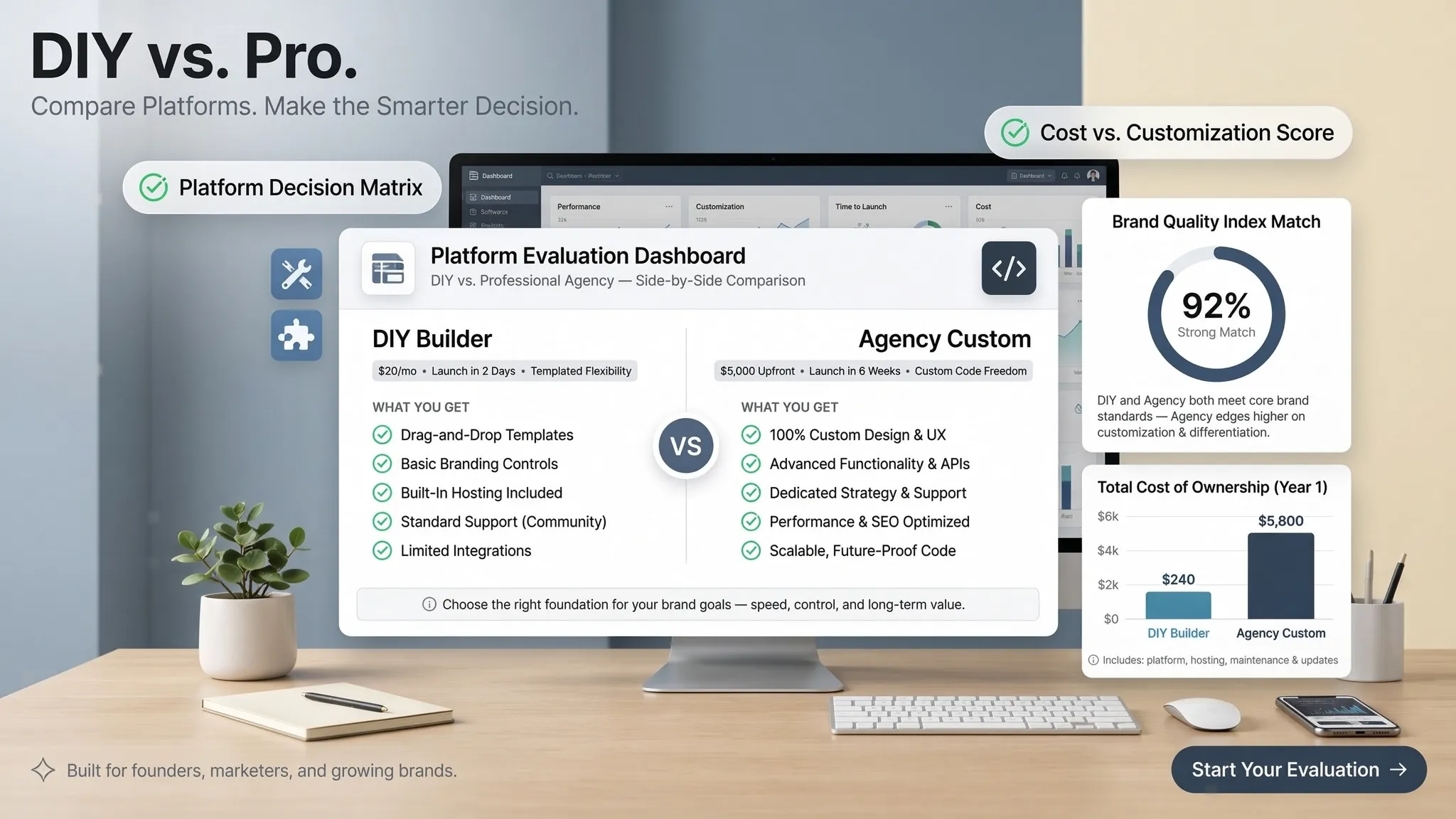
1. Website Builder vs Web Designer: Which Is the Better Choice for Your Business?
Let's clear up the main trade-off right away:
Choosing between a website builder or web designer isn't about finding a universal "winner." It is about matching your available budget, launch deadline, and required level of technical customization to the right tool.
If you operate a local trade service, professional practice, or growing retail shop, spending two months and $5,000 on a custom build often delays revenue unnecessarily. Using an intelligent builder lets you capture leads immediately. For a deeper comparison of approaches, read our guide on DIY website versus professional website options.
2. Understand What You Actually Get With Each Option
Before comparing invoices, it helps to establish clear definitions of what each path actually involves.
What is the operational difference?
- What is a website builder?: An all-in-one software platform that provides cloud hosting, pre-built design layouts, visual editing tools, and security. It enables business owners to build, publish, and manage a complete digital storefront without writing code.
- What does a web designer do?: A specialized professional or agency that manually plans user experiences, creates custom graphics, writes code, and builds bespoke web applications tailored to specific enterprise requirements.
Knowing these structural differences prevents unrealistic expectations down the road.
3. Compare the Total Cost, Not Just the First Price You See
Focusing purely on the headline price on a proposal can lead to unexpected financial surprises later on.
To calculate your true financial commitment, evaluate the complete 3-year expenditure:
When you evaluate web designer cost estimates, factor in hidden charges for extra revisions, staging server fees, and third-party plugin licenses. Comparing this against predictable website builder cost plans protects your operating cash flow over the long haul. For more on infrastructure pricing, read our guide on how much website hosting costs.
4. Decide How Much Time You Can Realistically Spend Building Your Website
Many business owners think hiring a designer means zero effort on their end.
Here is the plain truth:
Working with a custom agency requires dozens of hours spent reviewing wireframes, attending strategy meetings, providing feedback, and gathering business information.
- • 10+ hours in meetings
- • Weeks reviewing wireframes
- • 4 to 12 weeks to launch
- • 5 minutes providing inputs
- • Instant automated layout
- • Live in under 60 seconds
Weighing the decision to build a website yourself using an automated platform versus taking the time to hire a web designer comes down to how quickly you need your lead-capture system operational. To understand the speed advantage, read our article on how long it takes to build a website.

5. Choose Between Design Freedom and a More Guided Building Process
If you have highly unique design ideas and want exact pixel-level control over every visual element, working with a designer provides complete creative freedom.
However, unconstrained design freedom can sometimes lead to overly complex, slow-loading layouts that confuse visitors.
Evaluating website builder design flexibility against custom website design requires looking at user experience:
- Custom Agency Design: Delivers bespoke visual branding, but small layout tweaks usually require developer intervention.
- Visual Drag-and-Drop Editors: A modern drag-and-drop website builder provides structured layout grids that keep your pages looking balanced, responsive, and clean without visual clutter.
For more on visual editing, check out our guide on choosing a drag and drop website builder.
6. Choose Between a Custom Design or a Clear, Professional Layout
Does your business truly require a fully custom-coded website, or do you simply need a fast, high-converting digital storefront that ranks well on search engines?
For the vast majority of commercial operations, buyers care far more about clear pricing, fast loading speeds, easy phone links, and verified customer reviews than they do about custom web animations.
Evaluating a custom website vs website builder approach reveals that a clean, responsive layout paired with high-intent sales copy outperforms an overly elaborate custom site almost every time. Learn how to structure your pages effectively in our guide on website architecture mapping.
7. Know Who Will Write the Content and Supply the Images
Here is a common surprise that catches business owners off guard when hiring an agency: most web designers build layouts, but they expect you to provide all the written copy, service breakdowns, and field photography.
If you don't have time to write sales copy, your project stalls for weeks.
Clarify content production responsibilities early:
- Agency Route: You may need to hire a separate conversion copywriter or spend weekends drafting text yourself.
- Intelligent Builder Route: Advanced tools automatically handle website content creation, writing industry-specific copy, local SEO tags, and headlines for you out of the box.
For content generation strategies, read our guide on writing high-converting landing page copy.
8. Check Which Option Can Handle Your Business Features
Before picking a path, list the core functional tools your site needs to run day-to-day operations smoothly.
Ensure your chosen approach supports these primary business requirements:
- • Lead Intake Forms ➔ Instant email and SMS notification alerts
- • Online Booking ➔ A website builder with booking for calendar slots
- • Payment Portals ➔ A website builder with payments for deposits
Whether you need e-commerce checkouts or quote intake forms, verifying functional integrations upfront prevents costly technical hurdles after launch. For form setup, read our guide on adding lead forms to your website.
9. Know What Happens When Your Website Needs Updates
Imagine needing to update your holiday operating hours or add a new service subpage.
If you hire an agency, making a simple update often means submitting a support ticket, waiting three business days, and paying a $100 hourly fee.
Evaluating long-term website maintenance needs highlights the value of self-service access:
- Agency Retainers: You rely on outside developers for minor text edits and ongoing plugin updates.
- Self-Service Platforms: You retain complete control to update a business website instantly from any device without paying extra fees.
For ongoing management tips, see our article on what to do after launching a website.
10. Compare SEO, Performance, and Ownership Before You Commit
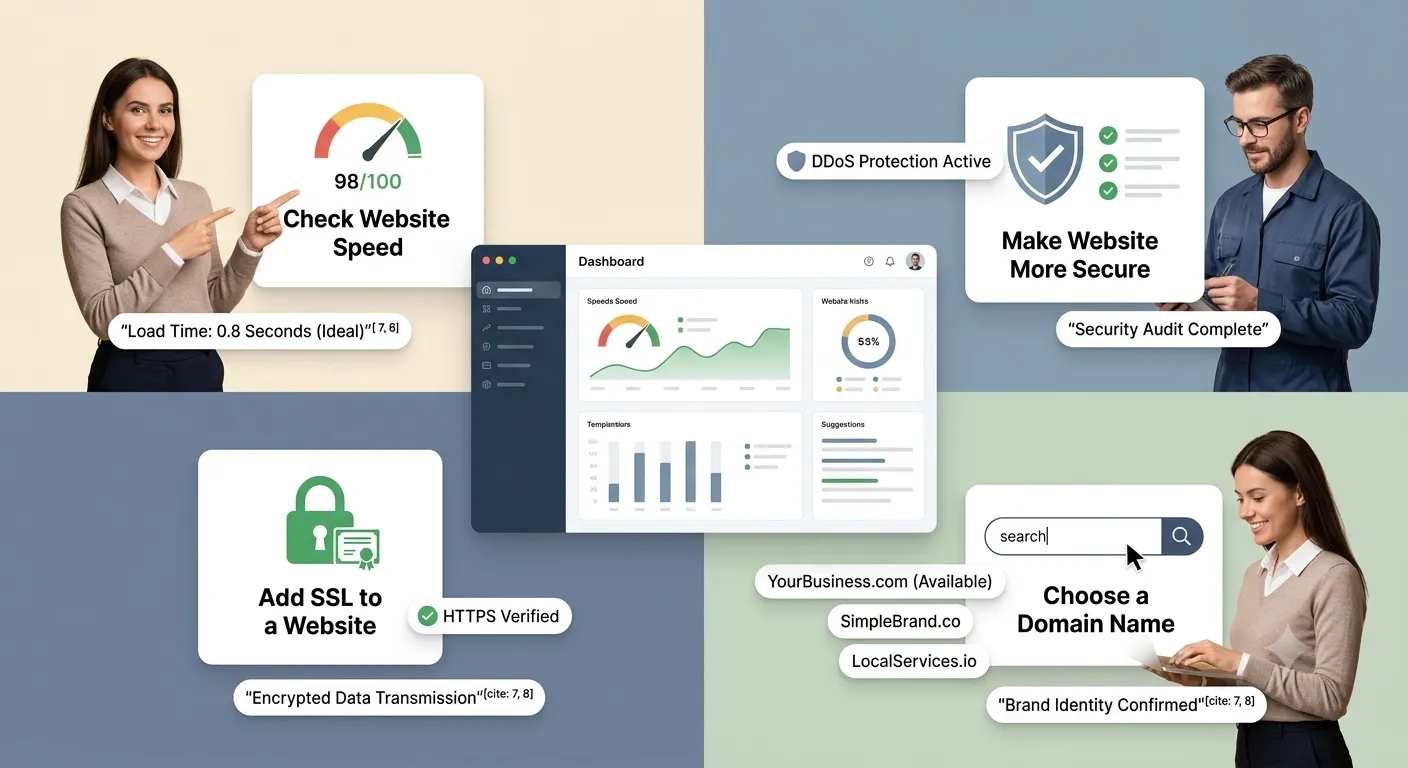
Your site can look incredible, but if it fails to load quickly or lacks key search tags, Google will ignore it—leaving your storefront invisible to nearby buyers.
Inspect technical fundamentals before making a commitment:
- SEO Controls: Choose an SEO-friendly website builder that lets you edit page titles, H1/H2 tags, meta descriptions, and clean subpage URLs (see setup steps in our guide on how to do SEO for a new website).
- Asset Ownership: Verify that you maintain full ownership of your custom web domain name and customer lead data.
- Loading Speed: Ensure your host uses fast cloud caching so mobile viewports load in under two seconds.
11. Use These Real-World Scenarios to Choose the Right Approach
To help clarify your decision, review these typical business scenarios:
Scenario A: Local Trade Service or Professional Practice
- Need: Fast launch, local Google ranking, simple quote forms, mobile phone buttons.
- Best Choice: An intelligent platform like BoltWeb delivers maximum speed, built-in local SEO, and low costs.
Scenario B: Large Enterprise with Complex Software Systems
- Need: Custom database integrations, proprietary user portals, bespoke software workflows.
- Best Choice: Hiring a specialized custom web design agency.
For more on choosing the right path, read our guide on how to choose the right website builder for your business.
12. Build It Yourself, Hire a Designer, or Combine Both Approaches
You don't have to choose between a clunky DIY experience and an overpriced design agency.
By building your storefront on BoltWeb, you gain the artistic structure, fast speed, and search-optimized copy of a professional agency, paired with the instant setup and low cost of a modern builder.
Take the Smart Route: Skip the long agency wait times, high development fees, and complex setup. Build your lead-generating digital storefront on BoltWeb today and start capturing qualified local clients in under 60 seconds!
Website Builder vs Web Designer: 12 FAQs to Help You Make the Right Choice
1. What is the difference between a website builder and a web designer?
Here’s the plain truth:
A website builder is an all-in-one platform that supplies hosting, security, responsive page layouts, and editing tools, allowing you to publish and maintain a storefront without writing code. A web designer is a specialist or agency hired to plan, design, and code custom digital experiences from scratch.
When you evaluate a website builder vs web designer, the choice comes down to speed, ongoing control, and total cost. Building your storefront on BoltWeb gives you the best of both worlds—combining agency-level visual design, search-optimized copy, and responsive layouts with instant, code-free editing control.
2. How do I determine whether my business needs a custom web design or a website builder?
A common mistake business owners make is assuming a custom-coded website automatically yields better business results.
Apply the Job-to-Be-Done (JTBD) framework to make your choice:
- High-Converting Storefront Needs: Local trade services, professional practices, and retail shops care about clear pricing, fast loading speeds, mobile phone links, and verified customer reviews. An SEO-friendly website builder delivers these features instantly at a fraction of agency costs.
- Complex Enterprise Systems: Large corporations requiring proprietary database portals or bespoke web applications usually require custom agency teams.
For the vast majority of commercial operations, clean responsive layouts paired with persuasive sales copy outperform overly complex custom designs.
3. What is the true cost comparison between a web designer and a website builder?
Evaluating proposals requires looking beyond the initial deposit invoice.
Calculate your complete operational commitment across three years:
When you evaluate web designer cost estimates, factor in hidden charges for extra revisions, staging server fees, and third-party plugin licenses. Comparing this against predictable website builder cost plans protects your operating cash flow over the long haul.
4. How much time do I need to invest when choosing between a website builder or web designer?
Hiring a custom agency rarely means zero work on your part.
Consider the time investment required for each route:
- Working with a Designer: Requires dozens of hours attending strategy sessions, reviewing wireframes, providing feedback, and gathering business materials over 4 to 12 weeks.
- Using an Intelligent Platform: Takes 5 minutes to supply your core business details and services, letting you generate a live storefront in seconds.
Weighing the decision to build a website yourself using an automated platform versus taking the time to hire a web designer comes down to how quickly you need your lead-capture system operational.
5. Will using a website builder limit my design flexibility compared to custom web design?
Many business owners worry that using a builder will result in a website that looks identical to three other local competitors using the exact same template.
Evaluating website builder design flexibility against custom website design comes down to system controls:
- Locked Templates: Rigid platforms offer fixed column widths and limited color options.
- Modern Visual Editors: Intelligent tools like BoltWeb give you total control over typography, brand color accents, section grids, and visual spacing without risking layout breakage.
Using a modern visual editor delivers complete brand customization while keeping your page structure balanced and responsive.
6. Who handles website content creation when I hire a web designer vs using an AI builder?
Here is a frequent surprise that catches business owners off guard: most web design agencies build layouts, but they expect you to write all the sales copy, service breakdowns, and headlines.
Clarify content responsibilities upfront:
- Agency Route: You must write the copy yourself or hire a separate conversion copywriter, which can delay launch timelines for weeks.
- Intelligent Builder Route: Advanced tools automatically handle website content creation, writing industry-specific copy, local SEO tags, and targeted headlines out of the box.
7. Can a website builder support essential business features like forms, bookings, and payments?
Before picking a platform or hiring an agency, list the exact functional tools your business needs to run daily operations smoothly.
Verify core capabilities inside your chosen platform:
- Lead Intake: Native quote forms that send instant notification alerts directly to your phone or inbox.
- Online Scheduling: A website builder with booking features that allows clients to reserve calendar slots automatically.
- Payment Gateways: A website builder with payments that processes credit card transactions or collects deposits securely.
Checking required integrations upfront prevents expensive plugin additions down the road.
8. What happens when my website needs updates, price changes, or new service pages?
Imagine needing to update your holiday hours, adjust pricing, or publish a new localized landing page.
Evaluating long-term website maintenance needs highlights the value of self-service access:
- Agency Retainers: You rely on outside developers for minor text edits, submitting support tickets and paying $100+ hourly rates.
- Self-Service Platforms: You retain complete control to update a business website instantly from any device without paying extra fees.
9. How do website builders compare to web designers when it comes to SEO and mobile performance?
Your website can look incredible, but if it loads slowly or lacks core search engine tags, Google will ignore it—leaving your storefront invisible to nearby buyers.
Ensure your chosen approach satisfies technical search standards:
- On-Page SEO Tags: Customizable page titles, H1/H2 heading hierarchies, meta descriptions, and clean URLs (see key setup steps in our guide on how to do SEO for a new website).
- Mobile Speed Optimization: Sub-2-second loading times on mobile devices with touch-friendly call buttons.
- Asset Ownership: Full legal ownership of your custom domain name and customer data.
10. Is a website builder suitable for a small business looking to scale?
Yes. Modern website builders are built on scalable cloud infrastructure capable of handling growing traffic volumes, expanded service catalogs, and new location pages without requiring a full site rebuild.
Deploying your site on a business website builder ensures your storefront grows alongside your operations without ongoing agency fees.
11. What are the common hidden costs when choosing a website builder vs web design agency?
Avoid financial surprises by reviewing full cost disclosures before signing a contract or subscription:
- Hidden Web Agency Costs: Scope creep fees, paid stock photography licenses, mandatory maintenance retainers, and staging server setup charges.
- Hidden Website Builder Costs: Separate domain renewal markups, transaction fees on e-commerce sales, and paid add-on plugins for basic forms.
Choosing an all-in-one platform with bundled hosting, SSL security, and native tools keeps your operating budget predictable.
12. What is the fastest path to launch a professional, high-converting business website today?
You don't have to choose between spending thousands on an agency or struggling with complex design tools.
By building your storefront on BoltWeb, you get the artistic polish, fast loading speed, and search-optimized copy of a professional web agency, combined with the instant setup and low cost of a modern builder. Build your lead-generating storefront today and start capturing qualified local clients in under 60 seconds!